Water Test Strip Chart

Professional water quality testing and analysis with comprehensive strip chart visualization
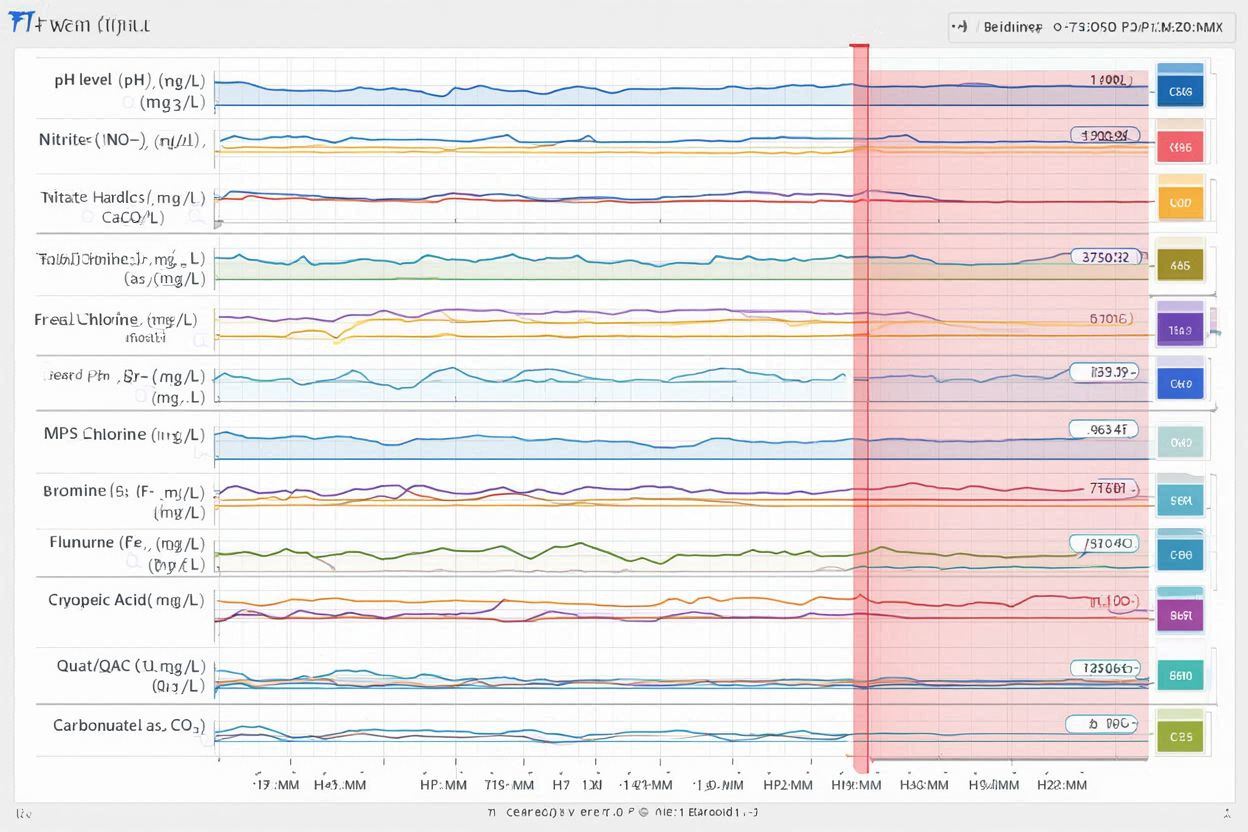
Water Test Strip Chart demo

Water Test Strip Chart Overview

Comprehensive Water Test Strip Chart monitoring for professional water quality testing and analysis

Water Test Strip Chart Purpose & Function

Water Test Strip Charts are professional-grade tools for monitoring comprehensive water quality parameters. They provide continuous visualization of critical water parameters with laboratory-grade accuracy for optimal water quality management.

  • Laboratory-grade accuracy
  • Comprehensive parameter coverage
  • Real-time monitoring capabilities
  • Professional water analysis

Water Test Strip Chart Key Features

Advanced strip chart technology provides comprehensive monitoring capabilities with professional-grade accuracy and reliability for water quality management.

  • Multi-parameter monitoring
  • Color-coded parameter tracking
  • Alert thresholds for critical levels
  • Historical data analysis
  • Automated trend detection

Water Test Strip Chart Parameters

Critical Water Test Strip Chart parameters for comprehensive professional water quality testing

pH Level

Normal Range: 6.5 - 8.5
What it means: pH measures water acidity/alkalinity. Proper pH ensures water safety and prevents corrosion.
Impact: Low pH causes corrosion; high pH affects taste and can cause scaling.

Total Hardness

Normal Range: 0 - 500 ppm
What it means: Concentration of calcium and magnesium minerals in water.
Impact: High hardness causes scaling; low hardness can cause corrosion.

Total Alkalinity

Normal Range: 40 - 200 ppm
What it means: Water's ability to resist pH changes, acts as pH buffer.
Impact: Low alkalinity causes pH instability; high levels make pH adjustment difficult.

Free Chlorine

Normal Range: 0.2 - 4.0 ppm
What it means: Active chlorine available to disinfect water and kill bacteria.
Impact: Low chlorine allows bacterial growth; high chlorine affects taste and health.

Total Chlorine

Normal Range: 0.2 - 4.0 ppm
What it means: Total chlorine including free and combined chlorine in water.
Impact: Indicates overall chlorine levels and disinfection effectiveness.

Nitrate

Normal Range: 0 - 50 ppm
What it means: Final product in the nitrogen cycle, indicates water contamination.
Impact: High levels indicate contamination and can cause health issues.

Lead

Normal Range: 0 - 0.015 ppm
What it means: Toxic heavy metal that can cause serious health problems, especially in children.
Impact: Any detectable lead is dangerous and requires immediate action.

MPS (Monopersulfate)

Normal Range: 0 - 10 ppm
What it means: Oxidizing agent used in pool and spa water treatment for sanitization.
Impact: High levels can cause skin irritation; low levels reduce sanitization effectiveness.

Iron

Normal Range: 0 - 0.3 ppm
What it means: Metallic element that can cause staining, taste, and odor problems in water.
Impact: High levels cause red staining, metallic taste, and can promote bacterial growth.

Bromine

Normal Range: 1.0 - 6.0 ppm
What it means: Alternative sanitizer to chlorine, commonly used in spas and hot tubs.
Impact: Low levels allow bacterial growth; high levels cause skin irritation.

Fluoride

Normal Range: 0.7 - 1.2 ppm
What it means: Mineral added to water to prevent tooth decay, but excessive amounts can be harmful.
Impact: Low levels reduce dental benefits; high levels can cause fluorosis and health issues.

Cyanuric Acid

Normal Range: 30 - 50 ppm
What it means: Stabilizer that protects chlorine from UV degradation in outdoor pools.
Impact: Low levels reduce chlorine effectiveness; high levels can cause chlorine lock.

Copper

Normal Range: 0 - 1.3 ppm
What it means: Metallic element that can cause blue-green staining and taste problems.
Impact: High levels cause staining, metallic taste, and can be toxic to aquatic life.

QUAT/QAC

Normal Range: 0 - 0.5 ppm
What it means: Quaternary ammonium compounds used as disinfectants and sanitizers.
Impact: High levels can cause skin irritation and reduce water quality.

Carbonate

Normal Range: 0 - 200 ppm
What it means: Carbonate ions that contribute to water alkalinity and pH buffering capacity.
Impact: Low levels cause pH instability; high levels make pH adjustment difficult.

Water Test Strip Chart Free Download PDF


Water Test Strip Chart Free Download PDF

You can Open PDF OR Free Download PDF

Water Test Strip Chart Visual Examples & Guide

Real-time Water Test Strip Chart examples and comprehensive interpretation guide

Water Test Strip Chart example

How to Read Water Test Strip Chart Results - Complete Guide

Safe Water Quality

All parameters stay within safe ranges. pH stable, hardness appropriate, chlorine effective, nitrate low.

Warning Signs

Parameters approaching dangerous levels. Immediate attention required to prevent health risks.

Critical Levels

Parameters outside safe ranges. Immediate corrective action required to prevent health hazards.

Traditional Water Test Strips vs Water Test Strip Chart

Understanding traditional water test strips and how they compare to modern Water Test Strip Charts

Traditional Water Test Strips - How to Read

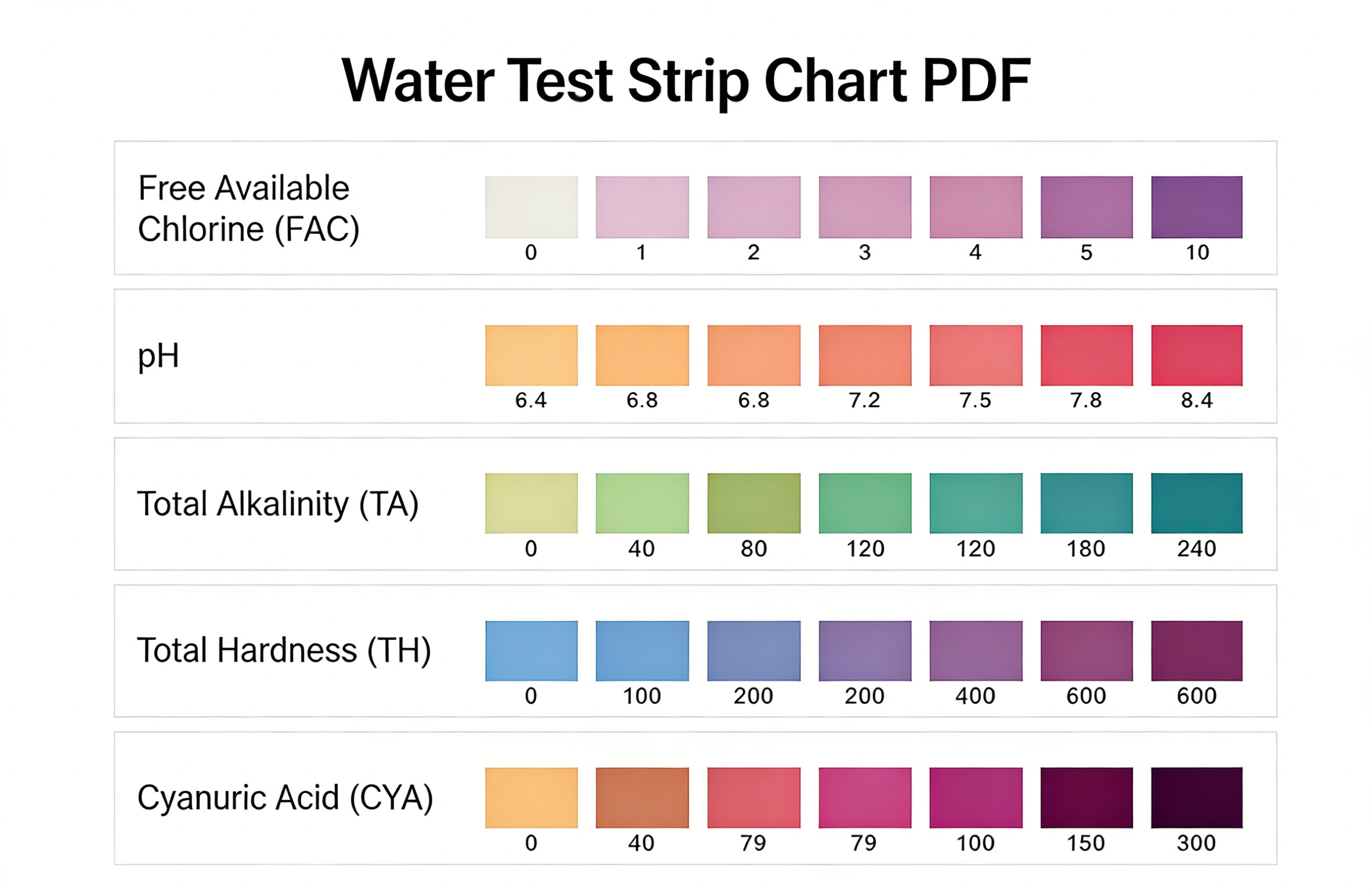
Water Quality Color Chart Reference

pH
6.5 - 8.5
Total Hardness
0 - 500 ppm
Total Alkalinity
40 - 200 ppm
Free Chlorine
0.2 - 4.0 ppm
Total Chlorine
0.2 - 4.0 ppm
Nitrate
0 - 50 ppm
Lead
0 - 0.015 ppm
MPS
0 - 10 ppm
Iron
0 - 0.3 ppm
Bromine
1.0 - 6.0 ppm
Fluoride
0.7 - 1.2 ppm
Cyanuric Acid
30 - 50 ppm
Copper
0 - 1.3 ppm
QUAT/QAC
0 - 0.5 ppm
Carbonate
0 - 200 ppm

How to Read Traditional Water Test Strips:

1
Dip the water test strip into water sample for 2 seconds
2
Remove immediately and shake off excess water
3
Hold strip level and compare colors within 15 seconds
4
Match each pad color to the corresponding chart color
5
Read the value range for each parameter

Traditional Water Test Strip Parameters Explained

pH Level

Normal Range: 6.5 - 8.5
What it measures: Water acidity/alkalinity balance for safety
Why it matters: Critical for water safety and prevents corrosion

Total Hardness

Normal Range: 0 - 500 ppm
What it measures: Concentration of calcium and magnesium minerals
Why it matters: High hardness causes scaling; low hardness causes corrosion

Total Alkalinity

Normal Range: 40 - 200 ppm
What it measures: Water's ability to resist pH changes
Why it matters: Acts as pH buffer to maintain stability

Free Chlorine

Normal Range: 0.2 - 4.0 ppm
What it measures: Active chlorine available to disinfect water
Why it matters: Essential for killing bacteria and ensuring water safety

Total Chlorine

Normal Range: 0.2 - 4.0 ppm
What it measures: Total chlorine including free and combined chlorine
Why it matters: Indicates overall chlorine levels and disinfection effectiveness

Nitrate

Normal Range: 0 - 50 ppm
What it measures: Final product in nitrogen cycle, indicates contamination
Why it matters: High levels indicate contamination and can cause health issues

Lead

Normal Range: 0 - 0.015 ppm
What it measures: Toxic heavy metal that can cause serious health problems
Why it matters: Any detectable lead is dangerous and requires immediate action

MPS (Monopersulfate)

Normal Range: 0 - 10 ppm
What it measures: Oxidizing agent used in pool and spa water treatment
Why it matters: High levels can cause skin irritation; low levels reduce sanitization

Iron

Normal Range: 0 - 0.3 ppm
What it measures: Metallic element that can cause staining and taste problems
Why it matters: High levels cause red staining, metallic taste, and bacterial growth

Bromine

Normal Range: 1.0 - 6.0 ppm
What it measures: Alternative sanitizer to chlorine, commonly used in spas
Why it matters: Low levels allow bacterial growth; high levels cause skin irritation

Fluoride

Normal Range: 0.7 - 1.2 ppm
What it measures: Mineral added to water to prevent tooth decay
Why it matters: Low levels reduce dental benefits; high levels can cause fluorosis

Cyanuric Acid

Normal Range: 30 - 50 ppm
What it measures: Stabilizer that protects chlorine from UV degradation
Why it matters: Low levels reduce chlorine effectiveness; high levels cause chlorine lock

Copper

Normal Range: 0 - 1.3 ppm
What it measures: Metallic element that can cause blue-green staining
Why it matters: High levels cause staining, metallic taste, and can be toxic

QUAT/QAC

Normal Range: 0 - 0.5 ppm
What it measures: Quaternary ammonium compounds used as disinfectants
Why it matters: High levels can cause skin irritation and reduce water quality

Carbonate

Normal Range: 0 - 200 ppm
What it measures: Carbonate ions that contribute to water alkalinity
Why it matters: Low levels cause pH instability; high levels make pH adjustment difficult

Traditional Water Test Strips vs Water Test Strip Chart Comparison

Traditional Water Test Strips

Advantages:
  • ✓ Simple and easy to use
  • ✓ No power or technology required
  • ✓ Portable and lightweight
  • ✓ Immediate visual results
  • ✓ Cost-effective for home testing
Limitations:
  • ✗ Manual testing only
  • ✗ No historical data tracking
  • ✗ Subjective color interpretation
  • ✗ Limited accuracy
  • ✗ No automated alerts

Water Test Strip Chart

Advantages:
  • ✓ Continuous real-time monitoring
  • ✓ Historical data and trends
  • ✓ Automated alerts and notifications
  • ✓ Precise digital readings
  • ✓ Professional-grade accuracy
  • ✓ Remote monitoring capabilities
Considerations:
  • ✗ Requires power and technology
  • ✗ Higher initial investment
  • ✗ More complex setup
  • ✗ Requires maintenance

When to Use Each Method:

Use Traditional Water Test Strips When:
  • • Home water quality testing
  • • Quick spot checks
  • • Portable testing needs
  • • Budget-conscious applications
  • • Backup testing method
Use Water Test Strip Chart When:
  • • Professional water quality management
  • • Commercial water facilities
  • • Continuous monitoring required
  • • Historical data analysis needed
  • • Automated alert systems

Water Test Strip Chart Parameter Troubleshooting Guide

Complete Water Test Strip Chart troubleshooting when water quality parameters are out of range

pH Too Low (< 6.5)

Symptoms: Corrosive water, metal leaching, health risks
Solution:
  • Add pH buffer or baking soda to raise pH
  • Check for acidic water source
  • Install pH correction system
  • Perform water treatment

pH Too High (> 8.5)

Symptoms: Bitter taste, scaling, reduced chlorine effectiveness
Solution:
  • Add pH down or acid to lower pH
  • Check for alkaline water source
  • Install pH correction system
  • Perform water treatment

Total Hardness Too High (> 500 ppm)

Symptoms: Scaling, soap scum, reduced cleaning effectiveness
Solution:
  • Install water softener
  • Use reverse osmosis system
  • Add water conditioner
  • Regular descaling maintenance

Free Chlorine Too Low (< 0.2 ppm)

Symptoms: Bacterial growth, water contamination, health risks
Solution:
  • Add chlorine to water system
  • Check chlorine injection system
  • Increase chlorine contact time
  • Check for chlorine demand

Nitrate Too High (> 50 ppm)

Symptoms: Water contamination, health risks, especially for infants
Solution:
  • Immediate water source change
  • Install nitrate removal system
  • Use reverse osmosis filtration
  • Check for contamination source

Lead Detected (> 0.015 ppm)

Symptoms: Serious health risks, especially for children, neurological damage
Solution:
  • Immediate water source change
  • Install lead removal system
  • Replace lead pipes and fixtures
  • Use certified lead-free water treatment

MPS Too High (> 10 ppm)

Symptoms: Skin irritation, eye irritation, respiratory problems
Solution:
  • Reduce MPS dosage
  • Increase water circulation
  • Check for over-treatment
  • Allow time for natural breakdown

Iron Too High (> 0.3 ppm)

Symptoms: Red staining, metallic taste, bacterial growth promotion
Solution:
  • Install iron removal system
  • Use iron sequestrants
  • Check for iron pipes or fixtures
  • Consider water source treatment

Bromine Too Low (< 1.0 ppm)

Symptoms: Bacterial growth, poor sanitization, health risks
Solution:
  • Add bromine tablets or liquid
  • Check bromine feeder function
  • Increase bromine levels gradually
  • Monitor pH levels

Fluoride Too High (> 1.2 ppm)

Symptoms: Dental fluorosis, bone problems, health risks
Solution:
  • Install fluoride removal system
  • Use reverse osmosis filtration
  • Check water source fluoride levels
  • Consider alternative water sources

Cyanuric Acid Too High (> 50 ppm)

Symptoms: Chlorine lock, reduced sanitization, cloudy water
Solution:
  • Dilute water to reduce cyanuric acid
  • Partial water replacement
  • Reduce cyanuric acid additions
  • Monitor chlorine effectiveness

Copper Too High (> 1.3 ppm)

Symptoms: Blue-green staining, metallic taste, toxicity to aquatic life
Solution:
  • Install copper removal system
  • Check for copper pipes or fixtures
  • Use copper sequestrants
  • Consider water source treatment

QUAT/QAC Too High (> 0.5 ppm)

Symptoms: Skin irritation, reduced water quality, foam formation
Solution:
  • Reduce QUAT/QAC dosage
  • Increase water circulation
  • Check for over-treatment
  • Use alternative sanitizers

Carbonate Too Low (< 40 ppm)

Symptoms: pH instability, corrosion, water quality issues
Solution:
  • Add carbonate buffer
  • Use baking soda or soda ash
  • Check water source alkalinity
  • Monitor pH stability

Water Test Strip Chart Generation Tools

Professional tools and software for creating advanced Water Test Strip Charts

Python

Create dynamic water test strip charts using matplotlib, plotly, or bokeh libraries.

Real-time data Custom styling Export options

JavaScript

Interactive web-based strip charts using Chart.js, D3.js, or custom Canvas implementations.

Web integration Interactive controls Responsive design

LabVIEW

Industrial-grade strip chart creation for automated water quality monitoring systems.

Industrial control Data logging Alarm systems

Excel

Simple strip chart creation using Excel's charting capabilities for basic water quality monitoring.

Easy setup Data analysis Report generation

AI Water Test Tools

AI-powered water test strip chart systems utilize machine learning and artificial intelligence to automatically analyze water quality data, predict trends, detect anomalies, and provide intelligent recommendations for optimal water quality management.

AI Analysis Predictive Analytics Auto Recommendations Smart Alerts

Currently Available AI Water Test Tools for Water Test Strip Chart:

  • WaterAI Smart Monitor: Advanced AI-powered water test strip chart analysis with predictive water quality monitoring
  • AquaAI Analytics: Machine learning-based water parameter analysis and optimization
  • WaterNeural System: Deep learning platform for water test strip chart prediction and management
  • SmartWater AI: Intelligent water test monitoring with automated parameter recommendations
  • WaterIntelligence Platform: Cloud-based AI system for comprehensive water test strip chart analysis
  • NeuralWater Monitor: AI-driven water test monitoring with source-specific recommendations
  • WaterPredict AI: Predictive analytics system for proactive water quality maintenance using test strip data
  • AquaSense Water AI: Intelligent water test strip chart interpretation with automated alerts
  • HydroAI Analytics: AI-powered water quality analysis with real-time strip chart monitoring
  • PureWater AI System: Comprehensive AI platform for water test strip chart analysis and optimization

How to Use Water Test Strip Charts

Step-by-step Water Test Strip Chart usage guide for effective professional water quality testing

1

Water Test Strip Chart Initial Setup

Configure your strip chart system with appropriate sensors and data collection intervals.

  • Install pH, hardness, chlorine, and nitrate sensors
  • Set data collection frequency (every 15-30 minutes)
  • Configure alert thresholds for each parameter
  • Calibrate sensors according to manufacturer instructions
2

Water Test Strip Chart Daily Monitoring

Regularly check strip chart readings and respond to any parameter deviations.

  • Review chart trends every morning
  • Look for sudden changes or gradual drift
  • Check for any alert notifications
  • Record observations in maintenance log
3

Water Test Strip Chart Weekly Analysis

Analyze weekly trends to identify patterns and optimize water treatment.

  • Review 7-day trend analysis
  • Identify recurring issues or patterns
  • Adjust treatment schedules if needed
  • Plan preventive maintenance actions
4

Water Test Strip Chart Maintenance Actions

Take corrective action based on strip chart readings and parameter analysis.
  • Perform water treatment as indicated by parameter readings
  • Adjust filtration and disinfection settings
  • Clean or replace equipment as needed
  • Document all maintenance actions