Pool Test Strip Chart

Professional swimming pool water quality monitoring with real-time strip chart visualization
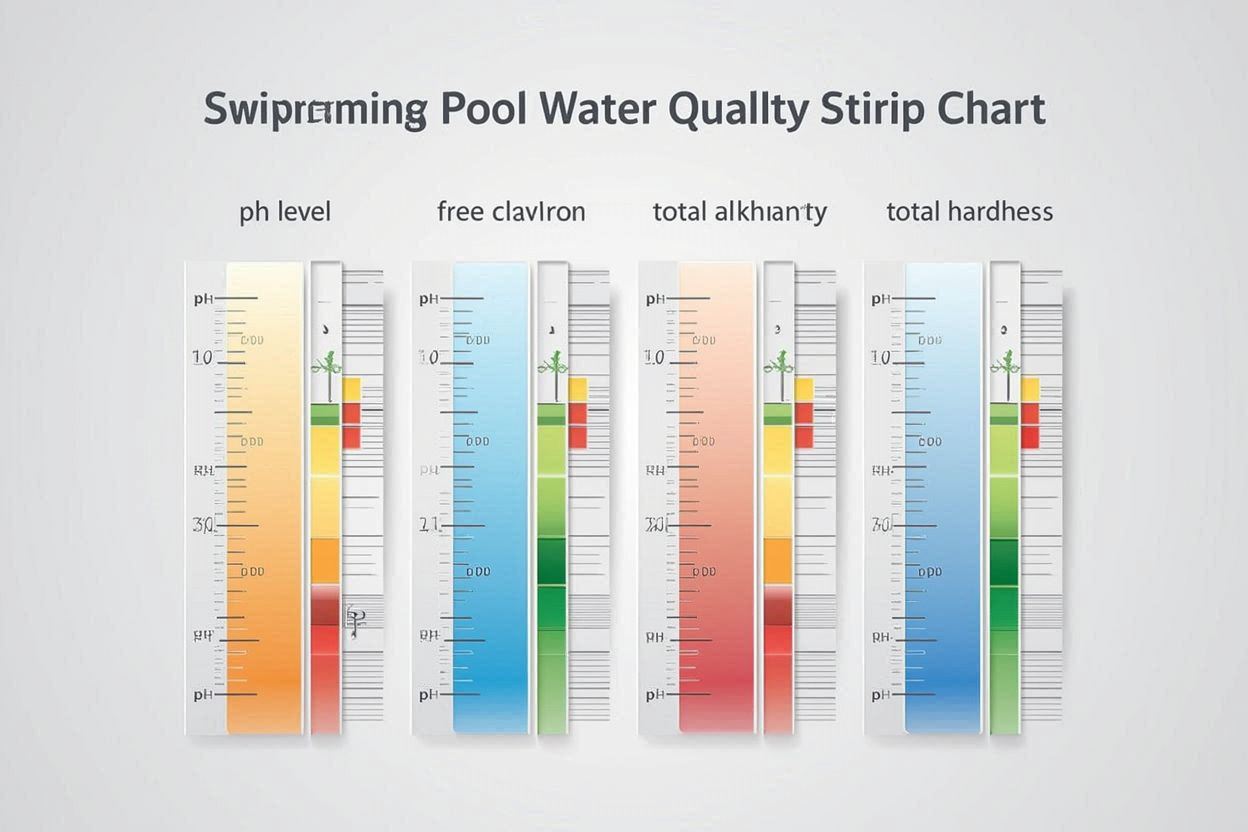
Pool Test Strip Chart demo

Pool Test Strip Chart Overview

Comprehensive Pool Test Strip Chart monitoring for swimming pool water quality analysis

Pool Test Strip Chart Purpose & Function

Pool Test Strip Charts are essential tools for monitoring swimming pool water quality in real-time. They provide continuous visualization of critical water parameters to ensure safe, clean, and properly balanced pool water.

  • Real-time water quality monitoring
  • Prevents algae and bacterial growth
  • Protects pool equipment from damage
  • Ensures swimmer safety and comfort

Pool Test Strip Chart Key Features

Advanced strip chart technology provides comprehensive monitoring capabilities with professional-grade accuracy and reliability.

  • Multi-parameter monitoring
  • Color-coded parameter tracking
  • Alert thresholds for critical levels
  • Historical data analysis
  • Automated trend detection

Pool Test Strip Chart Parameters

Critical Pool Test Strip Chart parameters for comprehensive swimming pool water quality analysis

pH Level

Normal Range: 7.2 - 7.8
What it means: pH measures water acidity/alkalinity. Proper pH ensures chlorine effectiveness and prevents skin/eye irritation.
Impact: Low pH corrodes equipment; high pH reduces chlorine effectiveness and causes scaling.

Free Chlorine

Normal Range: 1.0 - 3.0 ppm
What it means: Active chlorine available to kill bacteria and algae. Essential for water sanitization.
Impact: Too low allows bacteria/algae growth; too high causes skin irritation and equipment damage.

Total Alkalinity

Normal Range: 80 - 120 ppm
What it means: Water's ability to resist pH changes. Acts as a pH buffer to maintain stability.
Impact: Low alkalinity causes pH swings; high alkalinity makes pH adjustment difficult.

Total Hardness

Normal Range: 200 - 400 ppm
What it means: Concentration of calcium and magnesium minerals in water.
Impact: Low hardness corrodes surfaces; high hardness causes scaling and cloudy water.

Pool Test Strip Chart Visual Examples & Guide

Real-time Pool Test Strip Chart examples and comprehensive interpretation guide
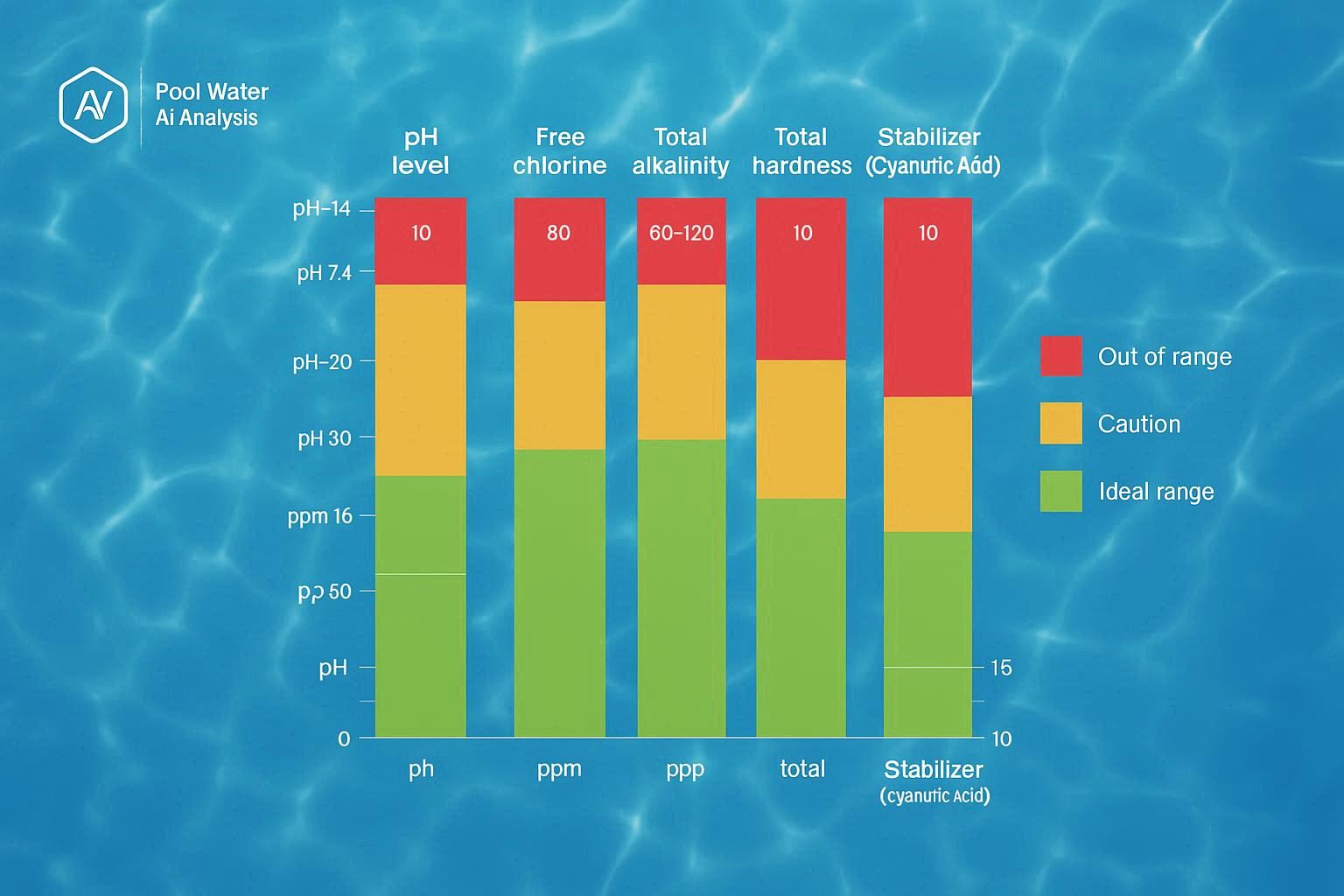
Pool Test Strip Chart example

How to Read Pool Test Strip Chart Results - Complete Guide

Normal Operation

All parameters stay within their normal ranges. Lines should be relatively stable with minor fluctuations.

Warning Signs

Parameters approaching or exceeding normal limits. Immediate attention may be required.

Critical Levels

Parameters outside safe ranges. Immediate corrective action required to prevent equipment damage and health risks.

Traditional Pool Test Strips vs Pool Test Strip Chart

Understanding traditional paper test strips and how they compare to modern Pool Test Strip Charts

Traditional Paper Test Strips - How to Read

Color Chart Reference

pH
6.2 - 8.4
Chlorine
0 - 10 ppm
Total Hardness
0 - 1000 ppm
Total Alkalinity
0 - 240 ppm
Stabilizer
0 - 300 ppm

How to Read Traditional Test Strips:

1
Dip the test strip into pool water at elbow depth for 2 seconds
2
Remove immediately and shake off excess water
3
Hold strip level and compare colors within 15 seconds
4
Match each pad color to the corresponding chart color
5
Read the value range for each parameter

Traditional Test Strip Parameters Explained

pH Level

Normal Range: 7.2 - 7.6
What it measures: Water acidity/alkalinity balance
Why it matters: Critical for chlorine effectiveness and swimmer comfort

Free Chlorine

Normal Range: 1.0 - 4.0 ppm
What it measures: Active chlorine available to sanitize water
Why it matters: Essential for killing bacteria and controlling algae

Total Chlorine

Normal Range: 1.0 - 4.0 ppm
What it measures: Total chlorine including free and combined chlorine
Why it matters: Indicates overall chlorine levels in the water

Total Hardness

Normal Range: 175 - 275 ppm
What it measures: Amount of calcium and other minerals in water
Why it matters: Prevents equipment damage and surface scaling

Total Alkalinity

Normal Range: 80 - 150 ppm
What it measures: Water's ability to resist pH changes
Why it matters: Acts as pH buffer to maintain stability

Stabilizer (Cyanuric Acid)

Normal Range: 30 - 50 ppm
What it measures: Amount of cyanuric acid protecting chlorine from sunlight
Why it matters: Extends chlorine life and reduces sun impact

Traditional Test Strips vs Pool Test Strip Chart Comparison

Traditional Paper Test Strips

Advantages:
  • ✓ Simple and easy to use
  • ✓ No power or technology required
  • ✓ Portable and lightweight
  • ✓ Immediate visual results
  • ✓ Cost-effective for occasional testing
Limitations:
  • ✗ Manual testing only
  • ✗ No historical data tracking
  • ✗ Subjective color interpretation
  • ✗ Limited accuracy
  • ✗ No automated alerts

Pool Test Strip Chart

Advantages:
  • ✓ Continuous real-time monitoring
  • ✓ Historical data and trends
  • ✓ Automated alerts and notifications
  • ✓ Precise digital readings
  • ✓ Professional-grade accuracy
  • ✓ Remote monitoring capabilities
Considerations:
  • ✗ Requires power and technology
  • ✗ Higher initial investment
  • ✗ More complex setup
  • ✗ Requires maintenance

When to Use Each Method:

Use Traditional Test Strips When:
  • • Occasional home pool testing
  • • Quick spot checks
  • • Portable testing needs
  • • Budget-conscious applications
  • • Backup testing method
Use Pool Test Strip Chart When:
  • • Professional pool management
  • • Commercial swimming facilities
  • • Continuous monitoring required
  • • Historical data analysis needed
  • • Automated alert systems

Pool Test Strip Chart Parameter Troubleshooting Guide

Complete Pool Test Strip Chart troubleshooting when water quality parameters are out of range

Key Parameter 1: pH

The most critical – affects chlorine effectiveness and swimmer comfort

Ideal Range: 7.2–7.8 (Optimal 7.4–7.6)

  • Below 7.2 (Acidic): Corrodes pool equipment, irritates skin/eyes, and causes chlorine to break down faster.
  • Above 7.8 (Basic/Alkaline): Causes cloudy water, scale buildup (on walls/pipes), drastically reduces chlorine's sanitizing power (as low as 10% of its effectiveness at neutral pH), and can make skin feel dry and itchy.
pH Reading Adjustment Direction Chemical to Use Dosage (per 1000 liters of water) Key Points
<7.2 (Too Acidic) Raise pH Sodium Carbonate (Soda Ash, Na₂CO₃) or Sodium Bicarbonate (Baking Soda, NaHCO₃) Soda Ash: 5-8g (raises pH by 0.1-0.2)
Baking Soda: 10-15g (raises pH by 0.1-0.2)
1. Baking soda raises pH gently and also slightly increases total alkalinity; ideal for slightly low pH (7.0-7.2).
2. Soda ash raises pH more significantly; suitable for low pH (<7.0).
3. Always pre-dissolve the chemical in a small amount of water before evenly pouring it around the pool edge with the circulation pump running.
>7.8 (Too Alkaline) Lower pH Sodium Bisulfate (pH Decreaser, NaHSO₄) or Hydrochloric Acid (HCl, ~30% concentration) Sodium Bisulfate: 8-12g (lowers pH by 0.1-0.2)
Hydrochloric Acid: 3-5ml (lowers pH by 0.1-0.2)
1. Sodium bisulfate is safer and recommended for beginners. Hydrochloric acid is corrosive—wear gloves/goggles and pour slowly along the pool wall to avoid splashing.
2. Never mix with chlorine-based chemicals (can produce toxic gas).
3. Run the circulation pump and apply the chemical in different areas of the pool to prevent localized over-acidification.

Key Parameter 2: Free Chlorine

Essential for sanitizing and preventing bacteria/algae

Ideal Range: 1–3 ppm (parts per million)

  • Below 1 ppm: Inadequate sanitization, leading to cloudy water and increased risk of algae growth.
  • Above 5 ppm: Can irritate skin and eyes, cause a strong chlorine odor, and damage swimsuits and pool equipment.
Free Chlorine Reading Adjustment Direction Chemical to Use Dosage (per 1000 liters of water) Key Points
<1 ppm (Too Low) Raise Chlorine Sodium Hypochlorite (Liquid Chlorine, 10-12%)
Trichlor (Chlorine Tablets/Granules)
Calcium Hypochlorite (Shock Powder, ~65% chlorine)
Liquid Chlorine: 10-15 ml (raises ~1 ppm)
Chlorine Tablet: 1 tablet (~20g, raises 1-1.5 ppm)
Shock Powder: 3-5g (raises ~1 ppm)
1. Liquid Chlorine: Pour evenly around the pool edge with the pump running. Avoid direct contact with the pool floor to prevent damage.
2. Chlorine Tablets: Always use a chlorinator or floater for slow dissolution. Never throw directly into the pool.
3. After adding chlorine, wait 2-4 hours with the pool closed and pump running before retesting and allowing swimmers back in (until FC is 1-3 ppm).
>5 ppm (Too High) Lower Chlorine 1. Natural Aeration (run pump, remove cover)
2. Sodium Thiosulfate (Chlorine Neutralizer)
Neutralizer: 1-2g (lowers ~1 ppm) 1. Natural aeration is the preferred method (safe, cost-free). It typically takes 12-24 hours to lower levels into a safe range.
2. Use a chlorine neutralizer only if a rapid reduction is needed. Dissolve completely before adding, circulate water well, and retest after 1 hour.

Key Parameter 3: Total Alkalinity

Acts as a pH buffer to prevent rapid fluctuations

Ideal Range: 80–120 ppm

  • Below 80 ppm: pH becomes unstable ("pH bounce") and difficult to maintain.
  • Above 150 ppm: Can cause cloudy water, make pH difficult to lower, and promote scale formation.
Total Alkalinity Reading Adjustment Direction Chemical to Use Dosage (per 1000 liters of water) Key Points
<80 ppm (Too Low) Raise Alkalinity Sodium Bicarbonate (Baking Soda, NaHCO₃) 15-20g (raises by ~10 ppm) 1. Baking soda is the preferred chemical for raising alkalinity as it is gentle and has a minimal immediate impact on pH.
2. Pre-dissolve and broadcast evenly around the pool with the circulation pump running. Retest after 2-4 hours.
3. If alkalinity is very low (<60 ppm), split the dose into two applications 4 hours apart to avoid overshooting the target.
>150 ppm (Too High) Lower Alkalinity Sodium Bisulfate (pH Decreaser) or Hydrochloric Acid (Muriatic Acid) pH Decreaser: 15-20g (lowers by ~10 ppm)
Muriatic Acid: 5-8ml (lowers by ~10 ppm)
1. The method is the same as for lowering pH, but larger quantities are typically required.
2. This process will also lower pH significantly. Monitor pH closely. If pH drops below 7.2, stop and adjust pH back up before continuing to lower alkalinity.
3. For very high levels, partial drainage (10-20%) and refilling with fresh water (which usually has lower alkalinity) may be the most practical solution.

Pool Test Strip Chart Generation Tools

Professional tools and software for creating advanced Pool Test Strip Charts

Python

Create dynamic pool test strip charts using matplotlib, plotly, or bokeh libraries.

Real-time data Custom styling Export options

JavaScript

Interactive web-based strip charts using Chart.js, D3.js, or custom Canvas implementations.

Web integration Interactive controls Responsive design

LabVIEW

Industrial-grade strip chart creation for automated pool monitoring systems.

Industrial control Data logging Alarm systems

Excel

Simple strip chart creation using Excel's charting capabilities for basic monitoring.

Easy setup Data analysis Report generation

AI System for Pool Test

AI-powered strip chart systems use machine learning and artificial intelligence to automatically analyze pool water quality data, predict trends, and provide intelligent recommendations.

AI Analysis Predictive Analytics Auto Recommendations Smart Alerts

What is AI System Strip Chart for Pool Test?

AI system strip charts integrate artificial intelligence with real-time pool monitoring to automatically interpret water quality data, identify patterns, predict potential issues, and recommend optimal chemical adjustments. These systems learn from historical data to improve accuracy over time.

Key Advantages:

  • Intelligent pattern recognition and anomaly detection
  • Predictive maintenance to prevent issues before they occur
  • Automated chemical dosing recommendations
  • Continuous learning from historical data
  • Multi-parameter correlation analysis
  • Energy optimization suggestions

Popular AI System Tools:

  • PoolAI Smart Monitor: Advanced AI pool management with predictive analytics
  • AquaSense AI: Machine learning-powered water quality optimization
  • SmartPool AI Analytics: Intelligent pool monitoring with automated recommendations
  • NeuralPool System: Deep learning-based pool maintenance prediction
  • IntelliPool AI: Cloud-based AI pool management platform

How to Use Pool Test Strip Charts

Step-by-step Pool Test Strip Chart usage guide for effective swimming pool water monitoring

1

Pool Test Strip Chart Initial Setup

Configure your strip chart system with appropriate sensors and data collection intervals.

  • Install pH, chlorine, and alkalinity sensors
  • Set data collection frequency (every 15-30 minutes)
  • Configure alert thresholds for each parameter
  • Calibrate sensors according to manufacturer instructions
2

Pool Test Strip Chart Daily Monitoring

Regularly check strip chart readings and respond to any parameter deviations.

  • Review chart trends every morning
  • Look for sudden changes or gradual drift
  • Check for any alert notifications
  • Record observations in maintenance log
3

Pool Test Strip Chart Weekly Analysis

Analyze weekly trends to identify patterns and optimize pool maintenance.

  • Review 7-day trend analysis
  • Identify recurring issues or patterns
  • Adjust chemical dosing schedules if needed
  • Plan preventive maintenance actions
4

Pool Test Strip Chart Maintenance Actions

Take corrective action based on strip chart readings and parameter analysis.

  • Add chemicals as indicated by parameter readings
  • Adjust pump and filter settings
  • Clean or replace equipment as needed
  • Document all maintenance actions